
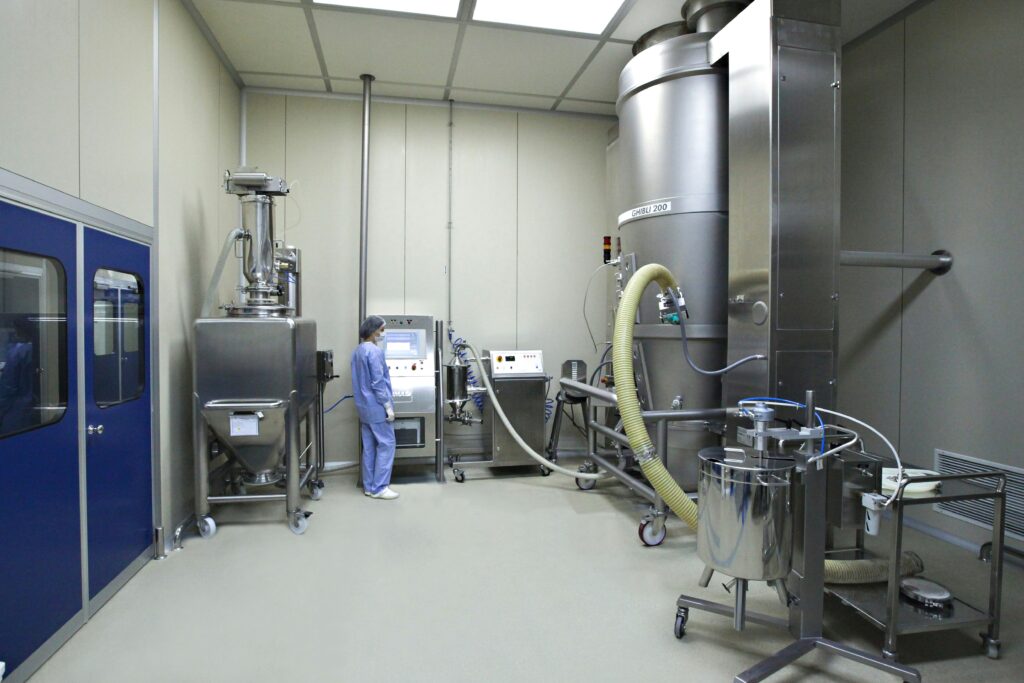
Bulk ingredients rarely arrive in a form that is easy to use. Powders come in large bins, granules in totes, and liquids or pastes in drums, and every one of them must eventually reach a mixer, hopper, or reactor. In food, pharmaceutical, and chemical plants, that last step carries two risks at once: injury to the worker who moves the material, and contamination of a product that must stay clean. Container tippers address both by lifting and tilting a full container so it empties by controlled mechanical action. The sections below look at where manual handling goes wrong, how tippers improve ergonomics, what washdown demands from the design, and how contamination control is built into the process.
Why Manual Emptying Causes Trouble
Emptying a heavy container by hand is a repetitive task with known hazards. Operators lift, tip, shake, and scrape, often at awkward angles and at heights that force them to bend or reach overhead. Muscle strain and back injuries are common outcomes, and the risk grows when workers handle the same task for entire shifts.
Quality problems appear alongside the injuries. Manual pouring releases dust, which can contaminate surrounding surfaces, create cross-contact between ingredients, and expose workers to airborne particles. In facilities that handle allergens, potent compounds, or reactive chemicals, that exposure is a serious concern. Spills add slip hazards and require cleanup time that interrupts production.
Inconsistency is another issue. When operators pour by hand, the rate at which material enters the process varies from person to person. That variation can affect batch uniformity, mixing times, and yield. A lift-assisted approach standardizes the movement and gives the process a predictable feed.
Before choosing equipment, document the current task: container size and weight, material behavior, discharge height, frequency per shift, and the surfaces where spills occur. The record shows which hazards are most pressing and sets the requirements for the replacement system.
Ergonomics Improve When Machines Take the Load
A container tipper replaces the lift with a mechanical one. The operator positions the full container, typically with a pallet jack or forklift, secures it, and operates a control that raises and tilts it to the discharge point. The heavy work is done by the machine, and the operator’s role becomes supervising and guiding.
A combo dumper is a common form of this equipment, built to hold a bin or tote and rotate it over a receiving hopper or vessel. Because the discharge height is set by the machine, operators no longer lift material to a mixer inlet or reach overhead to pour. The container clamps in place, and controls at a comfortable height prevent awkward postures.
Several design features contribute to safer handling. Two-hand controls keep hands away from moving parts. Guarding and light curtains stop motion if someone enters the working area. Controlled speed prevents sudden shifts that can send material flying. A combo dumper with adjustable tilt angles also lets the operator discharge slowly for dusty powders and faster for free-flowing granules.
Workstation layout deserves equal attention. Keep the loading area clear of obstacles, mark floor zones for pallet movement, and place bins where the operator can load without turning heavily. Equipment that cuts lifting but forces long walks or tight maneuvering only moves the strain elsewhere.
Washdown Design Determines Whether the Equipment Stays Clean
Hygienic production demands equipment that can be cleaned thoroughly and quickly. Stainless steel construction is the usual choice, since it resists corrosion from cleaning chemicals, does not shed particles, and tolerates repeated washdown. Grades such as 304 and 316 are common, with 316 favored where chlorides or aggressive chemicals are present.
Surface details matter as much as material. Continuous welds with smooth finishes leave no crevices where residue can collect. Rounded corners are easier to wipe than sharp internal angles. Sloped surfaces drain water rather than allowing it to pool, and open frame designs let spray reach every area.
A combo dumper intended for washdown should also protect its working parts. Sealed bearings, enclosed motors rated for wet environments, and stainless fasteners keep moisture and cleaning agents out of components that would otherwise corrode or harbor bacteria. Hydraulic systems, where used, need leak-resistant fittings and, in food applications, fluids rated for incidental contact.
Cleaning procedures should be written to match the equipment. Define the sequence: lockout of power, removal of gross residue, wash with approved detergent, rinse, sanitize, and dry. Check that the tipper can be reached from all sides during cleaning, and verify through inspection or swab testing that the process works. Equipment that is hard to clean tends to be cleaned poorly, and poor cleaning defeats the purpose of hygienic design.
Contamination Control Starts at the Discharge Point
The moment of discharge is when most contamination occurs, so the handling system should control that step directly. A well-designed process connects the tipper to the receiving vessel with a dust-tight interface, which limits both product loss and exposure of the surroundings.
Several measures work together:
- Use a docking or sealing arrangement between the container outlet and the receiving hopper, so material flows without release into the room.
- Add local dust extraction at the discharge point to capture fine particles that escape.
- Keep dedicated containers and tools for allergen or potent materials, with color coding or clear labeling to prevent mix-ups.
- Place the tipping area in a zone separated from finished product handling, with controlled airflow where the process requires it.
- Inspect liners and container surfaces on arrival, and remove outer packaging in a designated area before containers enter a clean room.
Changeover is another point of risk. When switching from one material to another, residue left in the equipment can cross into the next batch. Smooth, accessible surfaces and documented cleaning verification limit that risk. Pharmaceutical operations often require formal cleaning validation, with defined acceptance limits for residue.
Personnel practices complete the system. Training should cover how to load containers correctly, how to respond to blockages without reaching into the equipment, and how to report spills quickly. Even excellent equipment can be undermined by shortcuts.
Selecting and Installing the Right Equipment
Match the tipper to the application instead of choosing by price. Confirm the container dimensions and maximum filled weight, and include a safety margin on rated capacity. Check the discharge height required by the receiving vessel, since that determines the lift range. Consider material characteristics, such as stickiness, bulk density, and tendency to bridge, which affect the tilt angle and discharge time.
Review the regulatory and customer requirements for the facility. Food plants commonly follow hazard analysis programs and may need documentation of materials in contact with product. Pharmaceutical facilities look for traceable materials and cleanability that supports validation. Chemical plants may need explosion-protected designs for areas with flammable dust or vapors, and electrical components must match the area classification.
Plan installation with the whole workflow. Allow room for forklift or pallet jack approach, and ensure floors can handle the loaded equipment. Provide utilities, such as compressed air or power, in locations that avoid trailing hoses and cables across walkways.
After commissioning, train operators and maintenance staff, and set an inspection schedule covering welds, seals, guards, and safety interlocks. Keep spare wear parts available, and record any incidents or near misses so the process can be improved.
Final Analysis
Container tippers help hygienic plants solve two problems with one piece of equipment. They remove heavy lifting from operators, which reduces injury risk and makes the task more consistent. They also give the facility a controlled discharge point where cleanability and contamination control can be designed in rather than left to chance. Good results depend on careful selection, washdown-friendly construction, sealed transfer to the process, and disciplined cleaning and training. Plants that treat these elements together typically see a cleaner, safer, and more predictable material-handling step, with fewer interruptions from injuries, spills, or quality deviations.
 Nora P. has opinions about effective marketing strategies. Informed ones, backed by real experience — but opinions nonetheless, and they doesn't try to disguise them as neutral observation. They thinks a lot of what gets written about Effective Marketing Strategies, Business News and Insights, Financial Management Techniques is either too cautious to be useful or too confident to be credible, and they's work tends to sit deliberately in the space between those two failure modes.
Reading Nora's pieces, you get the sense of someone who has thought about this stuff seriously and arrived at actual conclusions — not just collected a range of perspectives and declined to pick one. That can be uncomfortable when they lands on something you disagree with. It's also why the writing is worth engaging with. Nora isn't interested in telling people what they want to hear. They is interested in telling them what they actually thinks, with enough reasoning behind it that you can push back if you want to. That kind of intellectual honesty is rarer than it should be.
What Nora is best at is the moment when a familiar topic reveals something unexpected — when the conventional wisdom turns out to be slightly off, or when a small shift in framing changes everything. They finds those moments consistently, which is why they's work tends to generate real discussion rather than just passive agreement.