
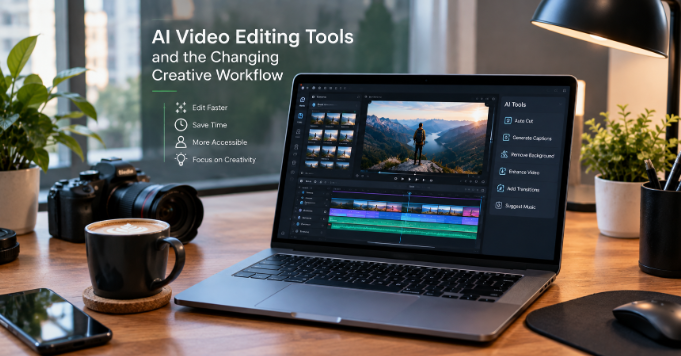
Editing videos is not just limited to editing and maybe making cuts in videos. Nowadays, the use of AI has increased in the video-making process to assemble raw footage, add subtitles and organize everything. It helps specialists in the video industry to significantly optimize their work.
Nevertheless, artificial intelligence does not replace creativity in editing. Rather, it helps at different stages of video production. Understanding the way this software functions might assist creators in selecting the most effective working approach.
What Makes AI Video Editing Different?
Traditional editing requires users to use manual means for most actions. Users will need to check the footage, choose clips, select scenes, time, and create other elements by using separate editing tools.
AI develops deeper assistance that helps the user to make an interpretation of his orders. This way, some operations in the production cycle can be done faster due to the large amount of raw material.
As an example of the process of creating a short film, a creator has a lot of things to do; he needs to spot necessary scenes, exclude irrelevant ones, insert subtitles and prepare and organize all footage. AI will help with the editing job, but the creator will keep working on editing.
Comparing Common Video Editing Approaches
Different editing methods serve different needs. Some creators prefer complete manual control, while others benefit from automated assistance.
| Editing Approach | Main Strength | Best Suited For | Level of Manual Work |
| Traditional desktop editor | Detailed creative control | Professional projects | High |
| Template-based editor | Faster visual production | Social media content | Medium |
| AI-assisted editor | Automation and workflow support | Fast content creation | Low to Medium |
| Natural-language editing | Simple instruction-based workflows | Beginners and creators | Low |
| Hybrid AI + manual editing | Balance of speed and control | Regular content production | Medium |
The analysis is an illustration that each creator cannot have a standard working organization. While a director may need to control every single step of the process, an influencer on social media may consider style and speed as a priority.
Using Natural Language for Editing Tasks
Among the more intriguing advancements in the realm of AI-generated videos is the capability to express editing requirements using plain language. Now, those involved in video work don’t need to sift through various menus to explain their expectations about the editing process.
This is especially useful in the initial stages of the editing process, e.g., when it comes to preparing the rough cut. One can ask the AI editor to ensure that selected clips get included in the cut, that various unimportant parts ought to be cut out, and that the whole project should be carried out at a certain speed.
For creators exploring a ChatGPT video editing tool, through the use of this workflow approach, the process of identifying the necessary editing requirements before proceeding to the actual video refinement also becomes easier to carry out. The aim is not to ensure that every decision is made using automated processes, but rather to enable a seamless interaction between the creator and editing software.
AI Can Help With Repetitive Production Tasks
The hours that an editor spends doing things related to repetitive processes can be rather high. Taking several recordings, writing subtitles, putting multiple sequences together, and reformatting the content may not require creative brain power like directing the video or working on the plot.
Systems that use some elements of artificial intelligence can significantly help in this area. Depending on the system, the user gets assistance in finding clips, writing subtitles, making templates, articulating visuals, etc.
The advantages of such machines become much more pronounced if a user produces more of similar content at once. For instance, a user making several editions on a weekly basis may spend less time on boring pre-production activities and increase the amount of time needed for the development of the message and its style.
Why Human Review Still Matters
Although automation has the potential to speed up the editing process, it is important to ensure that the quality is not sacrificed for the sake of speed. AI-generated selections or edits may still require thorough checking, as these systems do not always grasp the context of the video as a whole.
The creator will want to verify that vital information has been retained during editing, that the transitions feel fluid and natural, and that the captions are true to the audio. It’s also important that timing is taken into account. Overall, an edit may be technically accurate, yet feel paced too slowly, which risks alienating the audience.
For these reasons, human review is key to any workflow that uses AI, as the technology will only be able to provide a starting point from which the creator will ascertain whether the resulting clip fulfills its purpose.
Choosing the Right Workflow
The best editing method is determined by the goal of the project, time constraints, and amount of control required. For example, beginners may prefer software that makes complex features easier to use, while experienced editors want AI features that enhance their existing software rather than replace it.
In addition to method, format matters. Short videos on social media require quick templates and auto-generated captions, while longer educational or professional videos need more detailed manual adjustments.
Creators should keep in mind that it is more important to look at how well the features solve production challenges than simply count the number of available AI features. The software that eliminates repetitive work but allows some freedom in editing may be more useful than one with an overwhelming number of rarely used features.
Building a Balanced Editing Process
The future of video production may be a combination of automation and human creativity. AI may handle normal repetitive or organizational jobs, while the video creator is in charge of storytelling, tone, visual identity, and final presentation.
A balanced workflow may begin with deciding upon the aim of the video, followed by the AI-assisted organization or preliminary drafts. The creator could review the output, make minor corrections, and prepare the final version. This method assures that technology stays a supporter and artists get the most of fast production.
Conclusion
By utilizing artificial intelligence video editing applications, producers are discovering a new way to perform regular production tasks. These programs can carry out actions that previously may have required hours upon hours of labour, such as organizing videos based on natural language commands or giving assistance with captions.
However, creating videos effectively still requires human input. Generally, the most effective workflow combines artificial intelligence technology with effective human review, allowing producers to concentrate on the story they tell.
 Ask Elviaz Derrickson how they got into entrepreneurship tips and you'll probably get a longer answer than you expected. The short version: Elviaz started doing it, got genuinely hooked, and at some point realized they had accumulated enough hard-won knowledge that it would be a waste not to share it. So they started writing.
What makes Elviaz worth reading is that they skips the obvious stuff. Nobody needs another surface-level take on Entrepreneurship Tips, Effective Marketing Strategies, Financial Management Techniques. What readers actually want is the nuance — the part that only becomes clear after you've made a few mistakes and figured out why. That's the territory Elviaz operates in. The writing is direct, occasionally blunt, and always built around what's actually true rather than what sounds good in an article. They has little patience for filler, which means they's pieces tend to be denser with real information than the average post on the same subject.
Elviaz doesn't write to impress anyone. They writes because they has things to say that they genuinely thinks people should hear. That motivation — basic as it sounds — produces something noticeably different from content written for clicks or word count. Readers pick up on it. The comments on Elviaz's work tend to reflect that.
Ask Elviaz Derrickson how they got into entrepreneurship tips and you'll probably get a longer answer than you expected. The short version: Elviaz started doing it, got genuinely hooked, and at some point realized they had accumulated enough hard-won knowledge that it would be a waste not to share it. So they started writing.
What makes Elviaz worth reading is that they skips the obvious stuff. Nobody needs another surface-level take on Entrepreneurship Tips, Effective Marketing Strategies, Financial Management Techniques. What readers actually want is the nuance — the part that only becomes clear after you've made a few mistakes and figured out why. That's the territory Elviaz operates in. The writing is direct, occasionally blunt, and always built around what's actually true rather than what sounds good in an article. They has little patience for filler, which means they's pieces tend to be denser with real information than the average post on the same subject.
Elviaz doesn't write to impress anyone. They writes because they has things to say that they genuinely thinks people should hear. That motivation — basic as it sounds — produces something noticeably different from content written for clicks or word count. Readers pick up on it. The comments on Elviaz's work tend to reflect that.