
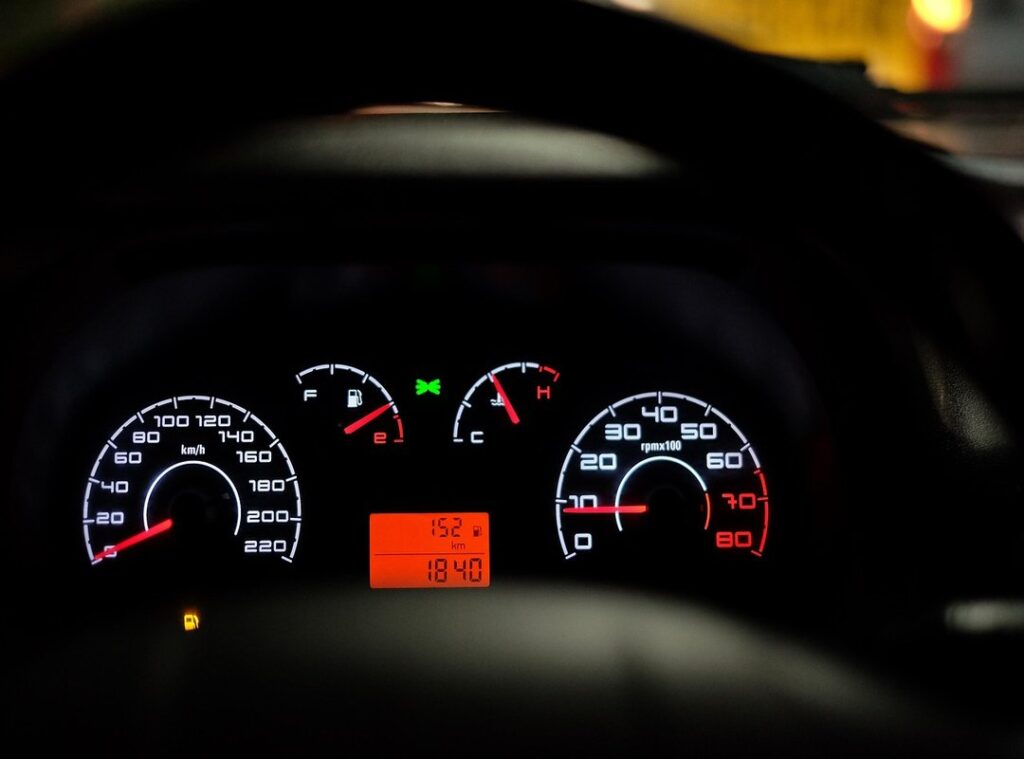
I’ve always found it fascinating how something as simple as a unit of speed can vary so much around the world. Miles per hour (MPH) is what we use here in the US. It’s straightforward: it tells you how many miles a vehicle or object would travel in one hour.
Kilometers per hour (KM/H), on the other hand, is the go-to for most of the rest of the globe. It measures how many kilometers are covered in an hour. The only real difference is the unit of distance—miles versus kilometers.
The time part stays the same.
Understanding both is crucial, especially if you travel a lot. Imagine renting a car abroad and not knowing the speed limits. Or watching a Formula 1 race and trying to figure out how fast those cars are really going.
It’s all about being prepared and not getting caught off guard.
The Simple Formula for Converting Miles Per Hour to Kilometers Per Hour
Let’s get straight to it. The single most important number for this conversion is the ‘magic number’ 1.60934. This is the number of kilometers in one mile.
Kilometers per Hour = Miles per Hour × 1.60934.
Why does this formula work? You’re just swapping the distance unit from miles to kilometers, so you only need to multiply by how many kilometers are in a mile.
For quick mental math, you can use a simplified version: multiply the mph value by 1.6. It’s not exact, but it gets you close enough for most everyday situations.
Here’s an easy example with a round number, like 100 mph. Using the formula: 100 mph × 1.60934 = 160.934 km/h.
If you want to convert 341 mph to km, just plug it into the formula: 341 mph × 1.60934 = 548.782 km/h.
This one formula is all you’ll ever need for this type of conversion. No need to overcomplicate it.
Calculating 341 MPH to KM/H: A Step-by-Step Walkthrough
Let’s get straight to it. We want to convert 341 mph into its km/h equivalent.
First, write down the starting value: 341 mph. 341 mph to km
Next, identify the conversion factor, and it’s 1.60934.
Now, set up the equation using our formula: Speed in km/h = 341 × 1.60934.
Perform the multiplication, and here’s the work:
341 × 1.60934 = 548.78494
The exact answer is 548.78494 km/h, which is commonly rounded to 548.78 km/h for practical use.
So, there you have it. 341 mph to km is 548.78 km/h. Simple and straightforward.
How Fast Is 341 MPH? Putting the Speed in Perspective

Let’s get one thing straight: 341 mph (548.78 km/h) is incredibly fast for any ground vehicle.
Imagine a Formula 1 car, which can reach around 230 mph (370 km/h). Even these high-performance race cars are left in the dust by 341 mph.
Now, think about a commercial airplane, like a Boeing 747, cruising at about 570 mph (920 km/h). While 341 mph isn’t quite up to that speed, it’s still in the same ballpark.
Consider the Bugatti Chiron Super Sport, the world’s fastest production car, which hit 304 mph (490 km/h). Even this hypercar can’t match 341 mph.
And then there’s the speed of sound, approximately 767 mph (1,234 km/h) at sea level. At 341 mph, you’re not breaking the sound barrier, but you’re definitely pushing the limits of what’s possible on the ground.
So, when you hear 341 mph, know that it’s a speed that even the most advanced vehicles struggle to achieve.
Converting Speeds
When converting speeds from miles per hour to kilometers per hour, it’s important to use the correct conversion factor. 341 mph to km is a specific conversion that requires multiplying 341 by 1.60934. This gives you the speed in kilometers per hour.
 Ask Elviaz Derrickson how they got into entrepreneurship tips and you'll probably get a longer answer than you expected. The short version: Elviaz started doing it, got genuinely hooked, and at some point realized they had accumulated enough hard-won knowledge that it would be a waste not to share it. So they started writing.
What makes Elviaz worth reading is that they skips the obvious stuff. Nobody needs another surface-level take on Entrepreneurship Tips, Effective Marketing Strategies, Financial Management Techniques. What readers actually want is the nuance — the part that only becomes clear after you've made a few mistakes and figured out why. That's the territory Elviaz operates in. The writing is direct, occasionally blunt, and always built around what's actually true rather than what sounds good in an article. They has little patience for filler, which means they's pieces tend to be denser with real information than the average post on the same subject.
Elviaz doesn't write to impress anyone. They writes because they has things to say that they genuinely thinks people should hear. That motivation — basic as it sounds — produces something noticeably different from content written for clicks or word count. Readers pick up on it. The comments on Elviaz's work tend to reflect that.
Ask Elviaz Derrickson how they got into entrepreneurship tips and you'll probably get a longer answer than you expected. The short version: Elviaz started doing it, got genuinely hooked, and at some point realized they had accumulated enough hard-won knowledge that it would be a waste not to share it. So they started writing.
What makes Elviaz worth reading is that they skips the obvious stuff. Nobody needs another surface-level take on Entrepreneurship Tips, Effective Marketing Strategies, Financial Management Techniques. What readers actually want is the nuance — the part that only becomes clear after you've made a few mistakes and figured out why. That's the territory Elviaz operates in. The writing is direct, occasionally blunt, and always built around what's actually true rather than what sounds good in an article. They has little patience for filler, which means they's pieces tend to be denser with real information than the average post on the same subject.
Elviaz doesn't write to impress anyone. They writes because they has things to say that they genuinely thinks people should hear. That motivation — basic as it sounds — produces something noticeably different from content written for clicks or word count. Readers pick up on it. The comments on Elviaz's work tend to reflect that.